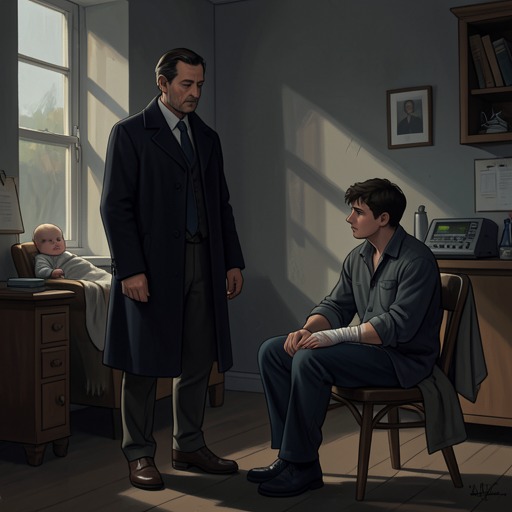
Joy tells Dominick she is HIV-positive and asks him to care for Tyffanie
I Know This Much Is TrueJoy’s letter to Dominick discloses that she is HIV-positive and asks him to consider taking responsibility for her baby, Tyffanie, if he tests negative and Joy becomes seriously ill. The event binds a new, frightening medical uncertainty to an intimate act of trust: Joy cannot bring herself to make the request face to face, and Dominick encounters it as both a confession and a possible future obligation.
The letter and its circumstances
Dominick finds the envelope hidden beneath Tyffanie’s changing blanket, folded on the arm of the living-room couch. He opens it with the wary care of someone handling a bomb; the comparison is his, and the letter does in fact detonate the assumptions he had been living with. Joy explains that she had hoped to find the courage to tell him in person, but wrote because she feared she would lose her nerve. Her written confession makes the letter a substitute for a conversation she cannot yet manage, and its concealment places the revelation among the ordinary objects of caring for a baby.
The letter also shows Joy trying to establish a workable life for herself and Tyffanie. She plans to move on August 1 and has already found temporary waitressing work at Denny’s, three nights a week, Monday through Wednesday. She intends to look for a job with benefits when she returns; her landlady will watch Tyffanie while she works. Joy acknowledges that the landlady has serious personal difficulties, including weighing more than three hundred pounds, but stresses that she is a licensed day-care provider and good with children. These arrangements give the letter a practical texture: even while disclosing a frightening illness, Joy is thinking about housing, employment, child care, and the conditions under which Tyffanie might be safe.
Diagnosis and uncertainty
Joy says that she learned she was HIV-positive during her pregnancy with Tyffanie, a time she had expected to be among the happiest of her life. She connects her infection to Thad’s conduct, explaining that he had not been as careful as he claimed in his other relationships. Her account makes his claimed precautions part of the betrayal: the danger has reached beyond their relationship and now touches the child’s health as well.
Tyffanie has been tested three times—twice in California and once in New Hampshire—and appears not to have the virus. Joy does not present that result as final. The baby must continue to be tested until eighteen months, and only then will the doctors know for certain; three doctors have nevertheless told Joy that they think Tyffanie will be fine and that the infection would likely have appeared by then. Joy clings to that possibility because it has helped keep her from despair. The letter thus holds reassurance and unresolved risk together: the available medical opinions offer hope, but not certainty.
The request concerning Tyffanie
Joy tells Dominick, “You have to get tested, Dominick,” and apologizes for asking. She says she has no right to make the request, but is desperate and expects that fear will prevent her from asking when she sees him. Her central plea is conditional, not an immediate transfer of care: if Dominick’s HIV test is negative, she asks him to consider taking Tyffanie only if Joy becomes very sick, or if her HIV develops into AIDS. She also acknowledges that this may never happen and that there may be a cure. The request is therefore made in the shadow of possible illness, not as a report that Joy is already dying.
Her fear is specifically that Tyffanie might end up with strangers or with people who would treat her badly. Joy does not want her own mother to raise the baby; she notes that her mother is fifty-one and has never wanted children. Against those feared alternatives, Dominick represents a person Joy knows and loves. She writes that Tyffanie and Dominick are the only people in the world who mean anything to her, and that she still loves him. The request consequently carries several meanings at once: it is an appeal for the child’s security, a declaration of continuing attachment, and an acknowledgment that Joy cannot guarantee what her health will allow her to do as a mother.
Dominick’s response and the stakes
Dominick reads the plea to get tested and stands numb. His thoughts move immediately from his own possible infection to Thomas’s: he wonders whether both twins are going to die, then asks where a person even gets an AIDS test. His next thought is about Ray and who would shave him if Dominick died. That abrupt sequence connects the new threat to the people already bound up in his daily life; even as Joy asks him to imagine caring for Tyffanie, Dominick’s mind measures the possible losses through his responsibilities to his brother and Ray.
Joy also tries to make sense of the request through Dominick’s bereavement. She suggests that God may have taken his daughter from him so that he could have her little girl, framing the thought as a possibility rather than knowledge of divine purpose. The appeal links Tyffanie’s uncertain future to Dominick’s loss, but it cannot make that loss or the prospect of illness simple. He lets the letter fall, goes to the bathroom, and vomits. That bodily reaction is the scene’s immediate consequence: the information and the responsibility arrive together, before Dominick has any answer about his test or any assurance about Joy’s future.